

I didn’t grow up eating stuffing, so I never understood why it took up room on the Thanksgiving table. Then I made this version, with toasted bread, crispy bacon, butter, and fresh herbs, and now I get it. The top bakes up crisp and the center stays soft. It actually tastes like the holiday.

This post may contain affiliate links. Read my disclosure policy.
Helpful Reader Review
“This recipe was the HIT of the table. EVERYONE was raving about the stuffing and there was not one lick left in the pan.” – Carol ★★★★★
Stuffing Recipe Video
Thanksgiving Stuffing Recipe
When I was developing this recipe, I polled my audience on Instagram and Facebook and did a lot of research and testing. I wanted a homemade stuffing that tasted like Thanksgiving and was still easy enough to make on a busy holiday. This is the one I landed on.

What’s the Difference Between Stuffing and Dressing?
People use the words interchangeably, but technically, stuffing is cooked inside the bird and dressing is baked in a casserole dish. This recipe works either way. I prefer baking it separately, especially if you’re making a Spatchcock Turkey, and I’ll also show you how to bake it in the turkey if that’s your tradition.
Here’s why I like the casserole better:
- Easier for a crowd – it’s simpler to serve and reheat
- Safer – stuffing inside a turkey has to reach 165˚F in the center so any poultry juices are fully cooked
- The turkey roasts faster without stuffing, with less risk of overcooking the breast
- Better texture – you get a crisp top and a soft center

Stuffing Ingredients
This recipe is flexible. You can make it vegetarian or gluten-free, and I’ve shared easy swaps below.
- Day-old bread – Bread that’s a few days old and dry will soak up the stock without getting soggy. I love the texture of Sourdough Bread, but white bread, French bread, rustic bread, ciabatta, sandwich bread, or Cornbread all work, and a mix is great too. For gluten-free stuffing, use gluten-free bread and dry it the same way.
- Bacon – The crisp bacon and the bacon fat add a lot of flavor. See the substitutions below if you want to use sausage, pancetta, or skip the meat.
- Unsalted butter – This adds flavor and moisture, and the extra butter dotted on top helps the crust.
- Onion and celery – These aromatics are the flavor base of the stuffing.
- Herbs and seasoning – I use salt, pepper, fresh parsley, rosemary, and garlic. If you want a more classic sage flavor, see the substitutions below.
- Chicken stock – Homemade Chicken Broth or Turkey Stock tastes best, but store-bought works too. Use vegetable stock if you’re making it vegetarian.
- Eggs – They help the casserole hold together.

Stuffing Substitutions
- Sausage – Ground sausage is a great swap for the bacon. Brown it, then cook the veggies in the drippings with the butter. If the sausage is extra fatty, use a little less butter.
- Pancetta or turkey bacon – These don’t give off as much fat as bacon, so add a little olive oil to the skillet.
- No bacon – Leave it out and use vegetable stock for a vegetarian stuffing.
- Sage or poultry seasoning – For a more traditional flavor, start with 1/2 teaspoon dried sage and 1 teaspoon poultry seasoning, then adjust to taste. Thyme or Italian seasoning also work.
- Bagged bread cubes – Plain dried stuffing cubes work. If they’re already seasoned, go easy on the salt and herbs.
How to Make Stuffing
- Toast the bread: Spread the cubes on a sheet pan and bake at 350°F for 12-15 minutes, until they’re crisp like croutons. Fresh bread may take a little longer. Transfer to a large bowl. You can do this 1-3 days ahead.

Natasha’s Pro Tip: Dry the Bread Well
The bread needs to be fully dried out, like croutons, before you add the stock. If it’s still soft in the middle, it turns gummy instead of soaking up the bacon and herbs.
- Sauté the bacon: Cook the bacon in a large skillet over medium heat until it’s browned and crisp, then sprinkle it over the bread.

- Sauté the veggies and herbs: Melt most of the butter into the bacon fat, then cook the onion, celery, garlic, and rosemary until the onion is very soft. Stir in the parsley, salt, and pepper, and pour this over the bread.

- Add the stock: Pour in half the chicken stock and mix. Whisk the rest of the stock with the eggs, then toss that through the bread until everything looks evenly moistened.

- Assemble and bake: Transfer the mixture to a greased 9×13 casserole dish, dot the top with the remaining butter, and cover with foil. Bake at 350°F for 40 minutes, then uncover and bake another 30-40 minutes, until the top is crisp and golden brown.

How to Know When Stuffing Is Done
The top should be crisp and golden, and the center should reach 165°F on an instant-read thermometer. You can keep baking if you want a little more crunch on top. I like it extra crisp.

To Bake Stuffing in a Turkey
After you add the stock in step 4, loosely spoon the mixture into the turkey cavity. Don’t pack it tightly, and roast the turkey right away. Don’t stuff it ahead of time. Cook until the turkey and the center of the stuffing both reach 165°F. Scoop the stuffing into a dish, fluff, and serve. For a crisper top, spread it in an oven-safe dish and broil for 1-2 minutes, watching closely so it doesn’t burn.
What to Serve with Stuffing
I serve this with turkey and the rest of the Thanksgiving spread, but it’s just as welcome with Baked Ham, Prime Rib, or Pot Roast.

Make-Ahead and Storage
I love layering leftovers with Cranberry Sauce, sliced Turkey, and Gravy on fresh bread for a sandwich that’s almost as good as the meal itself.
You can dry the bread 1 to 3 days ahead and cook the bacon, veggies, and herbs a day ahead, or bake the stuffing, cool it, and reheat it later. You can also assemble it in the casserole dish the night before, cover and refrigerate it, then bake it the next day. It keeps well in the fridge for a few days and freezes well too. To keep it warm for dinner, cover the baked stuffing and leave it in a low oven. The recipe card has the details.
If you were like me and never saw the point of stuffing, try this one. I think you’ll get it too.
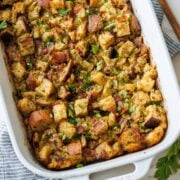
Stuffing Recipe
Ingredients
- 1 1/4 lb day-old bread, sourdough, white bread, French bread, rustic bread, ciabatta, cut into 1/2” to 3/4” cubes (about 12–14 cups)
- 6 oz bacon, chopped into 1/4-inch pieces, or diced pancetta
- 12 Tbsp unsalted butter, divided, plus more to grease the pan
- 2 medium yellow onions, (2 cups finely chopped*)
- 3 celery stalks, (2 cups finely chopped*)
- 1 tsp fine sea salt, or to taste *if using salted butter, reduce to 1/2 tsp
- 1 tsp freshly cracked black pepper, or to taste
- 1/2 cup finely chopped flat-leaf parsley, plus more to garnish
- 1 1/2 Tbsp finely chopped fresh rosemary, from 3 Tbsp rosemary leaves
- 4 garlic cloves, minced
- 2 cups low-sodium chicken stock, divided (or vegetable stock)
- 2 large eggs
Instructions
- Toast the bread – Preheat the oven to 350˚F. Grease a 9×13 casserole dish then set aside. Set the bread on a large rimmed baking sheet and bake for 12-15 minutes or until fully dried out and crisp like croutons. If bread is fresher, it will take 5-10 minutes longer. Transfer to a large mixing bowl.*
- Sauté the bacon – Heat a large skillet over medium heat and sauté the bacon until browned and crisp (if using pancetta, you’ll need to add some olive oil since it doesn’t release as much fat as bacon). Remove the bacon with a slotted spoon and sprinkle it over the bread.
- Sauté the veggies and herbs – Into the bacon grease, carefully melt in 8 Tbsp of butter, then add onion and celery, garlic, and rosemary, and sauté until onions are very soft, about 6-8 minutes, stirring often. Stir in the parsley, salt, and pepper, then pour the onion mixture over the bread crumbs and stir.
- Add stock – Slowly add half of the chicken stock to the bowl and mix it all together. In a separate bowl, whisk together the remaining chicken stock and eggs, then pour over the bread mixture and toss everything until combined.**
- Assemble and Bake – Transfer the mixture to your prepared 9×13 casserole dish, dot the top with the remaining 4 Tbsp of butter. Cover with foil and bake at 350˚F for 40 minutes, then uncover and bake until the top is crisp and golden brown, another 30-40 minutes.
Notes
- Prep Ahead – Dry the bread 1–3 days ahead and store it at room temperature. Chop the veggies, herbs, and bacon, then sauté them 1 day ahead. Cool completely, cover, and refrigerate.
- Overnight – Assemble the stuffing in the casserole dish, cover, and refrigerate overnight (up to 1 day). Let it sit at room temperature for about 30 minutes while the oven heats, then bake as directed, adding 5 to 10 minutes if needed. Don’t stuff the turkey ahead of time.
- Keep Warm – Cover the baked stuffing with foil and keep it in a warm oven (200–225°F) for up to 45 minutes.
- Make-ahead – Bake and cool stuffing within two hours, then cover and refrigerate for up to 4 days or freeze for up to 3 months. Thaw in the fridge overnight before reheating.
- Reheat in the oven at 350˚F for 15 minutes (you can cover it with foil), or reheat portions in the air fryer for 6-7 minutes, until edges are crispy and the center reaches 165°F.
- To scale – Use the servings adjuster at the top of the card to scale this up or down. A doubled batch fits best in two 9×13 pans, not one large pan.


